Every conversation Fin answered first, scored.
Where it ended up, how it got there, and what your rubric made of the reply. Fin is graded on the same rubric as your agents, so for the first time the two numbers mean the same thing.
In build now · no launch date yet · one email when it ships
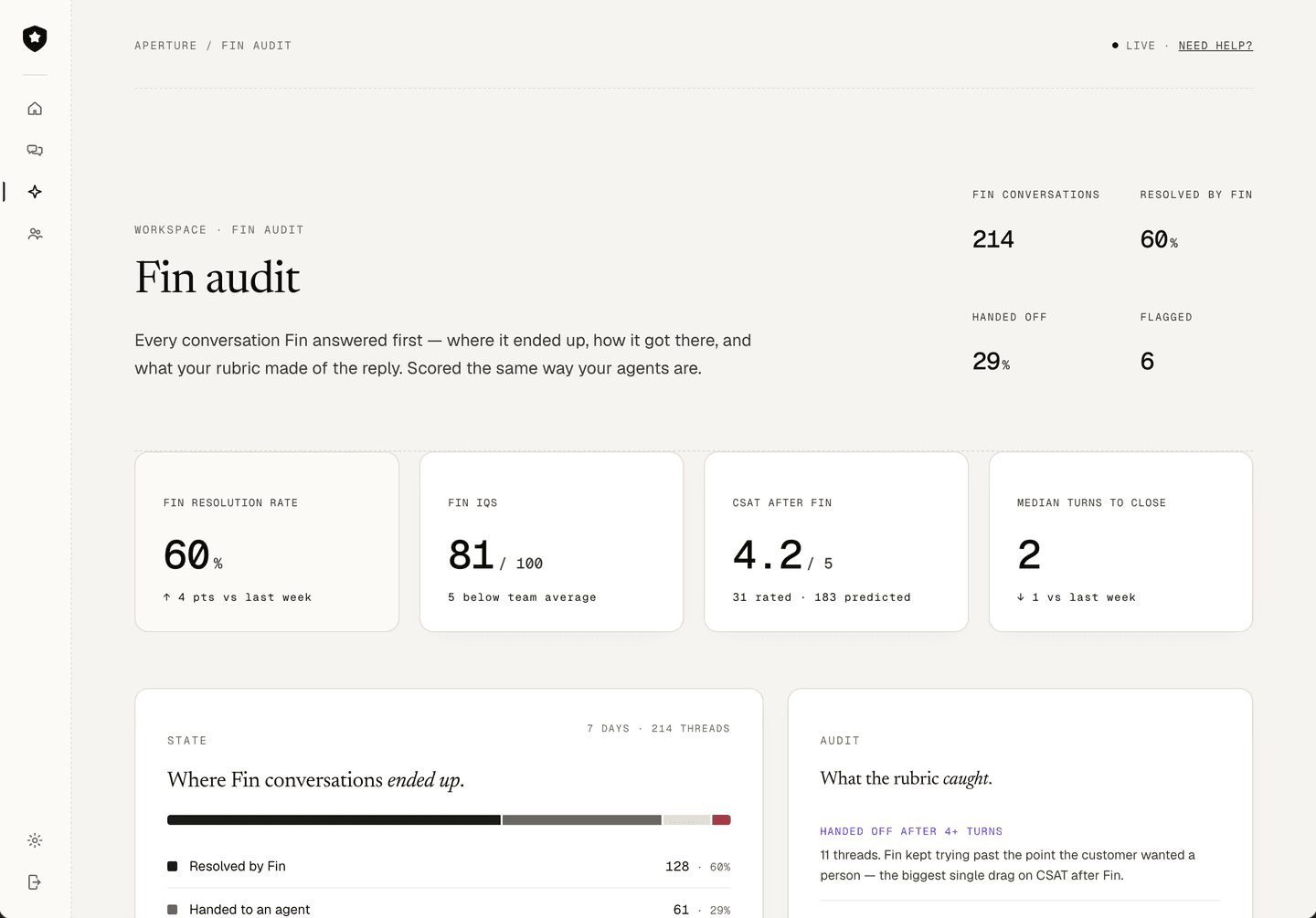
Resolution rate on its own tells you almost nothing.
A conversation can close because Fin solved it, or because the customer gave up. Both count as one. The dashboard leads with four numbers that pull those apart.
Fin resolution rate
60%
The share Fin closed without a human. Trended week over week, so a drop shows up as a number rather than a feeling.
Fin IQS
81/100
Your rubric, applied to Fin. Shown against the team average, so you can see whether Fin is answering better or worse than the humans it stands in for.
CSAT after Fin
4.2/5
Rated where the customer left a score, predicted where they did not, so a 15% response rate does not hide the other 85% of the volume.
Median turns to close
2
How many back-and-forths it takes Fin to finish. The number that quietly climbs when the answer is nearly right but never quite.
Four endings, not one.
Every Fin thread lands in one of four states. Three of them are usually reported as a single "unresolved" bucket, which is why nobody ever fixes them.
- Resolved by Fin
- Fin answered and the thread ended there. The volume you were promised, and worth checking the score on anyway.
- Handed to an agent
- Fin tried, then passed it on. The interesting question is which turn it handed off at, and whether it should have gone sooner.
- Routed out
- Out of scope and sent elsewhere: a sales inbox, another team. Not a failure, and not scored.
- Abandoned
- The customer left mid-thread. No rating, no resolution, and invisible in a plain resolution-rate chart.
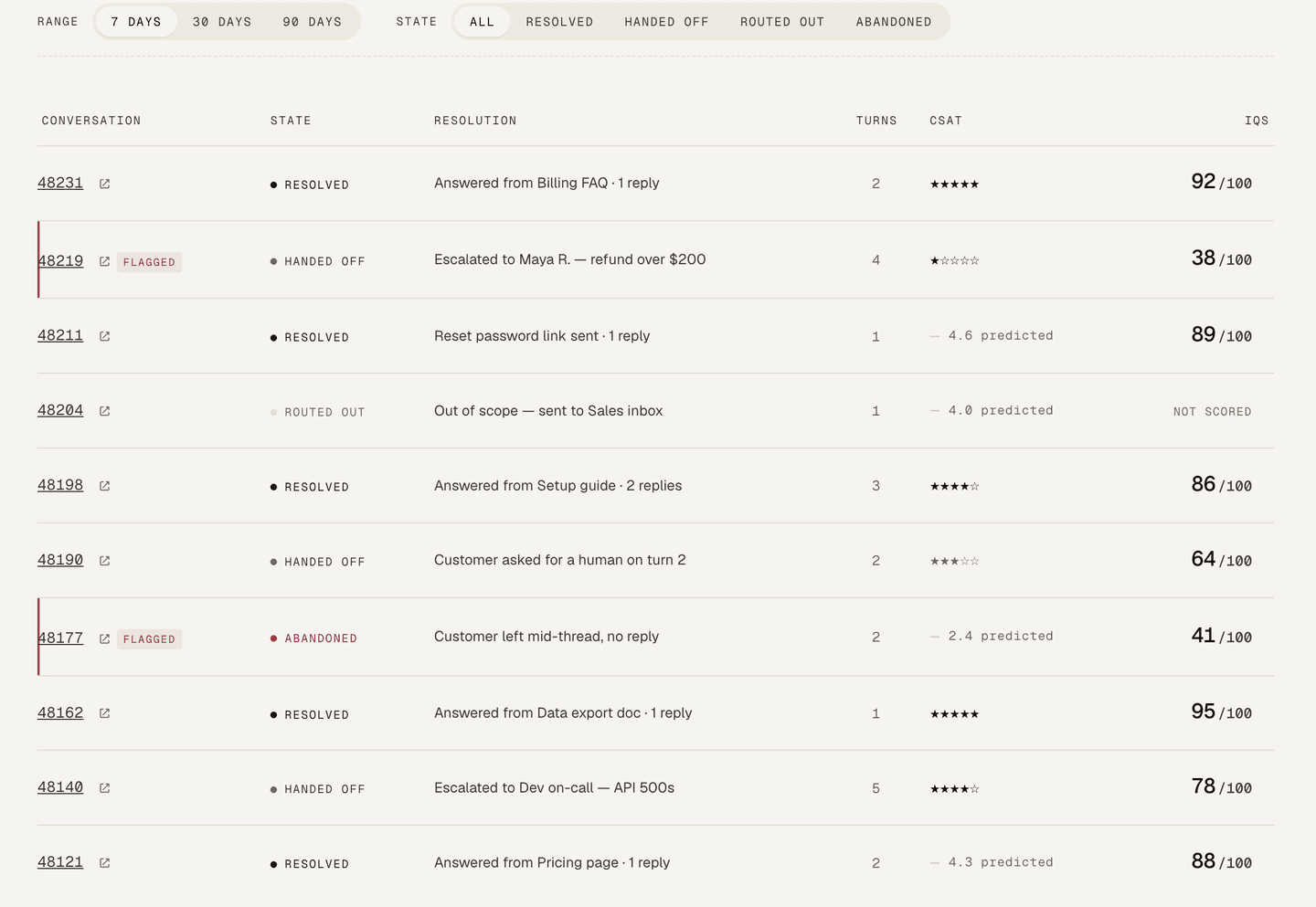
A score you can click into.
Dashboards that stop at the aggregate get admired and ignored. Every row here is a real conversation, one click from the thread in Intercom.
Filter to the ugly ones
Range across 7, 30 or 90 days and narrow by state: resolved, handed off, routed out, abandoned. Start where it hurts.
Read the resolution line
"Answered from Billing FAQ · 1 reply." "Escalated to Maya R., refund over $200." What Fin actually did, in one line, before you open anything.
Follow the flags
Threads the rubric marked are pinned with a flag and a reason. Six flags in a week is a reading list, not a report.
The failures that don't look like failures.
Fin rarely fails loudly. It closes the ticket, the customer doesn't rate it, and the number stays green. These are the patterns the audit surfaces.
Handed off after 4+ turns
Fin kept trying past the point the customer wanted a person. Usually the single biggest drag on CSAT after Fin.
Closed without answering
The thread ended, but the rubric could not find the answer in it. Counts as resolved; is not.
Abandoned mid-thread
The customer walked away. No survey to catch it, so nothing else in your reporting will tell you.
Scored well below the team
Fin answered, on-topic, and still landed under the bar your agents are held to.
Be told when it ships.
The Fin Audit dashboard is in build. Leave your email and we'll send one message the day it goes live. No drip sequence, no newsletter.
Already using Supportman for agent QA? Fin will be scored on the rubric you've already set up. Nothing to reconfigure.
Get notified at launch
One email when the Fin Audit dashboard is live.
What is the Fin Audit dashboard?
A quality view for the conversations Intercom Fin answers before a human sees them. It shows where each one ended up (resolved, handed off, routed out or abandoned) and scores the reply against the same QA rubric you already use on your agents.
How is this different from Intercom’s own Fin reporting?
Intercom reports resolution rate. This audits the reply itself. Every Fin thread gets an IQS score against your rubric, a CSAT number (rated where the customer left one, predicted where they did not), and a flag when the pattern looks wrong, so you can see the difference between a conversation that closed and one that was actually handled well.
What does IQS mean?
IQS is the Supportman quality score, 0 to 100, produced by grading a conversation against your rubric. Fin is scored on the same rubric as your human agents, so a Fin thread and an agent thread are directly comparable.
What is a predicted CSAT?
Most conversations never get rated. Where a customer left a rating, the dashboard shows it. Where they did not, it shows a predicted score derived from the conversation itself, so a survey response rate in the teens does not leave the rest of your volume invisible.
When does it launch?
It is in build now and we have not set a public date. Add your email and we will send you one message when it is live. Nothing else.
Do I need to be a Supportman customer to get access?
No. Anyone on the notify list gets told when it ships. It will require an Intercom workspace with Fin turned on to be useful.
Want the manual version today? We run one-off Fin audits while the dashboard is in build. You can also explore our complete guides and calculators in the Fin library.